

A Child Ran Into the Street on Halloween. Can the Driver Still Be Liable?
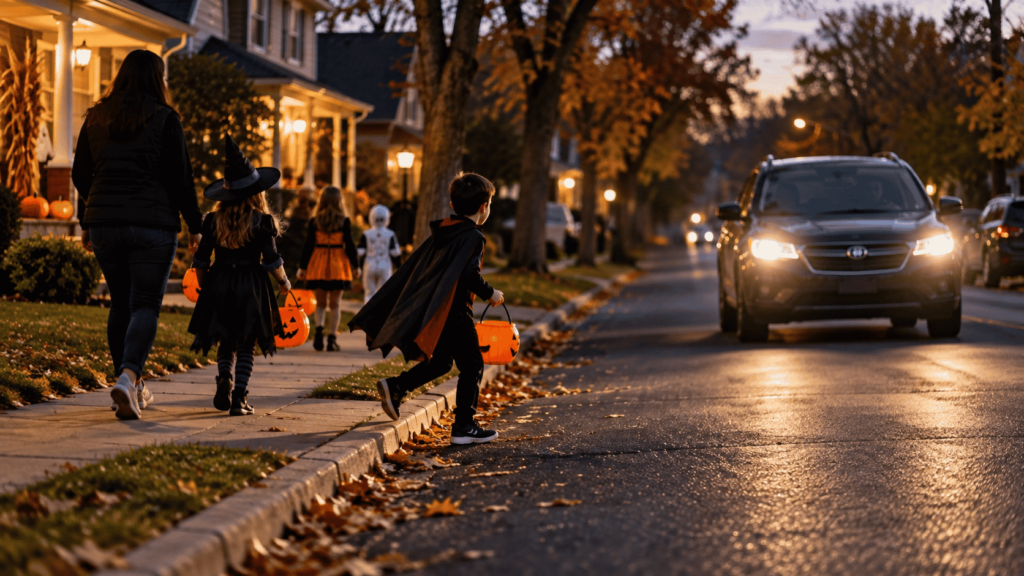
Your child is trick-or-treating in a New Jersey neighborhood, moving from one house to the next with friends or family.
Then, in a matter of seconds, your child steps or runs into the street and is struck by a vehicle.
Once your child’s immediate medical needs are being addressed, another question can quickly surface: If your child entered the roadway unexpectedly, does that automatically mean the driver cannot be responsible?
Not necessarily.
New Jersey law places responsibilities on pedestrians, including rules about entering a roadway in front of an approaching vehicle. But those rules do not automatically eliminate a driver’s responsibility to use reasonable care for pedestrians.
When a pedestrian accident involves a child, age and the circumstances surrounding the collision can become especially important.
How Does a Child Running Into the Street Affect Liability?
No single fact necessarily determines who was responsible for a pedestrian accident.
Under New Jersey’s pedestrian law, a pedestrian cannot leave a curb or other place of safety and walk or run into the path of a vehicle that is so close the driver cannot yield or stop.
The same law, however, also states that drivers are not relieved of their duty to exercise due care for the safety of pedestrians.
That distinction matters.
Consider two different situations. In one, a child suddenly runs from behind a parked vehicle directly into the path of a driver who has almost no time to react. In another, a driver is traveling too fast through a neighborhood where children are visibly trick-or-treating and does not slow down before the child enters the roadway.
Both accidents involve a child entering the street. The circumstances leading up to the collision are very different.
Why Can Halloween Conditions Affect Who Was Responsible?
Halloween does not create a separate legal standard for drivers. But the circumstances surrounding an accident can matter when evaluating whether someone acted reasonably.
On Halloween evening, residential neighborhoods can have more children walking near roadways than on an ordinary evening. Cars may line both sides of the street, while darkness, costumes, groups of pedestrians, and children moving between homes can affect visibility and reaction time.
Those conditions can make questions about the driver’s conduct especially important.
Was the vehicle traveling at an appropriate speed for the conditions? Were children already visible along the roadway? Were parked cars obstructing the driver’s view? Was the driver distracted? Did the driver brake or attempt to avoid the collision once the child became visible?
The fact that the accident happened on Halloween does not establish negligence. It can, however, provide important context for determining what the driver could see and how the driver responded.
What If the Driver Says the Child “Came Out of Nowhere”?
After a pedestrian accident, a driver may say there was simply no opportunity to stop.
That statement can be important, but it should be evaluated against the available evidence.
A careful investigation looks at where the child entered the roadway, whether parked vehicles or other objects blocked the driver’s view, how fast the vehicle was moving, the lighting conditions, when the child first became visible, and how much time or distance the driver had to react.
The driver’s actions in the moments before impact can also be important. Phone use, acceleration, braking, or failure to notice other pedestrians nearby can help provide a more complete picture of what happened.
That is why one person’s description of the collision should not be treated as the complete picture of who was responsible.
Does It Matter If the Child Was Outside a Crosswalk?
It can.
New Jersey law treats pedestrians in crosswalks differently from pedestrians crossing elsewhere. A pedestrian who crosses outside a marked crosswalk or an unmarked crosswalk at an intersection generally must yield the right-of-way to vehicles on the roadway.
But being outside a crosswalk does not automatically answer every question about driver responsibility.
The pedestrian statute also preserves a driver’s obligation to use due care for the safety of pedestrians. The child’s location, the distance between the child and the vehicle, the driver’s speed, sightlines and lighting, and the driver’s opportunity to react can all be relevant to determining responsibility.
For that reason, whether the child was in a crosswalk is important, but it is not the only question that can affect who was responsible.
Can a Child Be Considered Partly Responsible?
Possibly, but New Jersey does not evaluate a child’s conduct under the same standard used for an adult.
The child’s age, intelligence, experience, and ability to understand and avoid the danger can affect whether the child is considered negligent.
For children under seven, New Jersey recognizes a rebuttable presumption that the child is not capable of negligence. That presumption can be overcome only if there is sufficient evidence that the particular child had the experience and capacity to understand and avoid the danger involved.
This can become important in a child injury claim when an insurer argues that a child caused the accident simply by entering the roadway.
If a child is found capable of negligence, comparative fault can also become part of the case when more than one person’s conduct contributed to the accident. Any assessment of responsibility must take into account the conduct of everyone involved and the legal standard that applies to each person.
What Evidence Can Help Show How the Accident Happened?
A Halloween pedestrian accident can happen in seconds, but evidence from the surrounding neighborhood can help reconstruct the moments before impact.
At Bramnick Law, we look at the available evidence to understand what the driver and child were doing before the collision, what each could see, and how much time the driver had to respond.
Doorbell cameras may have captured the child approaching the road or the vehicle traveling down the street. Home-security systems, footage from nearby businesses, dashcams, witness accounts, and police observations may provide additional information.
Photographs can also help document street lighting, parked vehicles, sightlines, crosswalks, traffic signs, and the location where the collision occurred.
Some of this evidence can disappear quickly. Doorbell and surveillance footage may be overwritten, vehicles may be repaired, and people’s memories can become less precise over time.
Preserving available evidence early can therefore be an important part of determining how the accident happened.
What Should Parents Do After a Child Pedestrian Accident?
Your child’s medical needs come first.
After those immediate needs are addressed, preserve what you can. Keep medical records and discharge instructions, obtain the police report when available, save photographs and videos, identify witnesses, and avoid discarding damaged clothing or other potentially relevant items.
If nearby homes or businesses have cameras that could have captured the collision, make note of those locations so the footage can be requested as soon as possible.
Parents should also be cautious about assuming that the driver’s version of events, the location of the child, or an initial insurance assessment settles the question of fault.
Determining what happened often requires looking closely at the entire sequence leading to the collision, not just the child’s location at the moment of impact.
Getting Answers After a Child Pedestrian Accident
After a child pedestrian accident, responsibility is not always clear from the first account of what happened. Understanding the full circumstances can be especially important when the driver and the child’s family have different accounts of how the collision occurred.
At Bramnick Law, we represent injured people and families throughout New Jersey. When a child is hurt in a pedestrian accident, our attorneys can review what happened, explain the legal issues that affect the claim, and help families understand their options.
If your child was struck by a vehicle while trick-or-treating or crossing a road, contact Bramnick Law to discuss what happened and learn what steps can help protect your child’s rights.
Disclaimer: The articles on this blog are for informative purposes only and are no substitute for legal advice or an attorney-client relationship. If you are seeking legal advice, please contact Bramnick, Grabas, Arnold, Robotham, Trembly and Holtz, LLC directly.